Turning vision tests into meaningful monitoring
-
OKKO Health
-
Researcher
UX designer
UI designer
-
End-to-end redesign of the results experience
OKKO Health needed to redesign its vision results experience to increase repeat engagement and ensure patients clearly understood the value of monitoring their eyesight at home.
While the product successfully measured vision changes for people living with AMD, user behaviour showed a significant drop-off after initial tests. The challenge was not clinical accuracy, but perception… Users did not always understand what their results meant or why continued testing was important.
The goal of this project was to reframe how results were communicated, reduce anxiety and misinterpretation, and position OKKO as a supportive monitoring companion rather than just a vision test.
Process
-
Usability testing with AMD patients
Behavioural data analysis (drop-off patterns)
Competitor analysis (health & habit-forming apps)
Emotional journey mapping
Thematic analysis (Attride-Stirling framework)
-
Clear problem statement (value perception vs feature gap)
“How might we increase repeat testing?” framing
Engagement and value success metrics
Tone and language guardrails
Results communication principles (“usual visual range”)
-
Multiple results visualisation concepts
Copy iterations to reduce anxiety and misinterpretation
Accessible UI system (WCAG-aligned)
“Building vision range” onboarding state
Interactive Figma prototype (end-to-end flow)
-
Moderated usability testing (value & comprehension focus)
Iterated results experience
Design framework for ongoing engagement
My approach
I started by looking at both sides of the experience: what the data was telling us about user behaviour, and what patients were telling us about their experience.
I conducted moderated usability sessions with people living with AMD, analysed drop-off patterns and mapped the emotional journey through the results experience.
A key finding was that people often interpreted an individual test result as a definitive statement about their eyesight. They weren't necessarily seeing it as one data point within a longer-term picture.
This changed the problem I was trying to solve.
Rather than asking:
How can we make the result more engaging?
I asked:
How can we help people understand what their results mean over time?
Making the data meaningful
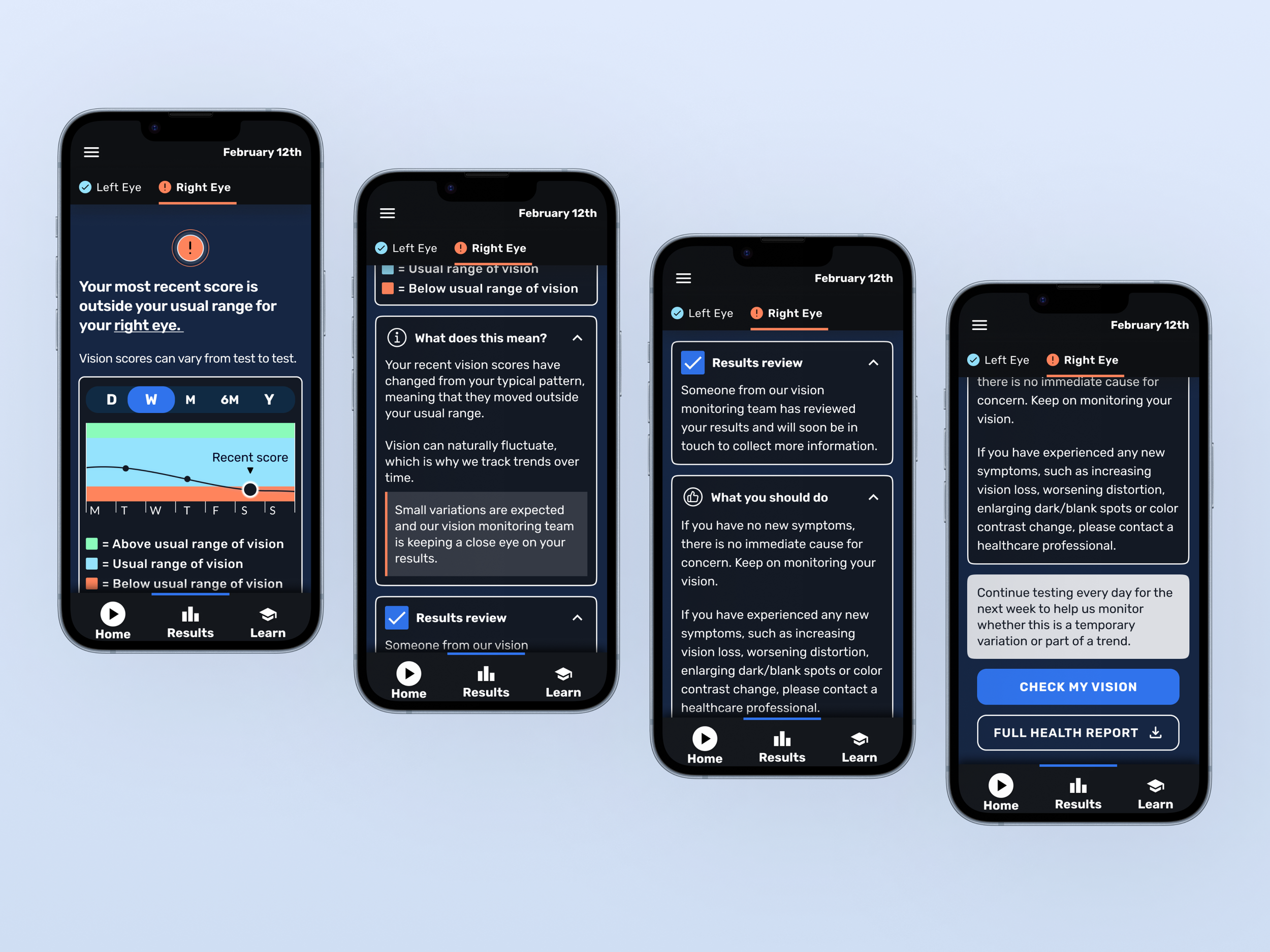
The existing experience focused heavily on individual scores. I explored a number of ways of showing results that could communicate change without requiring users to interpret clinical information themselves.
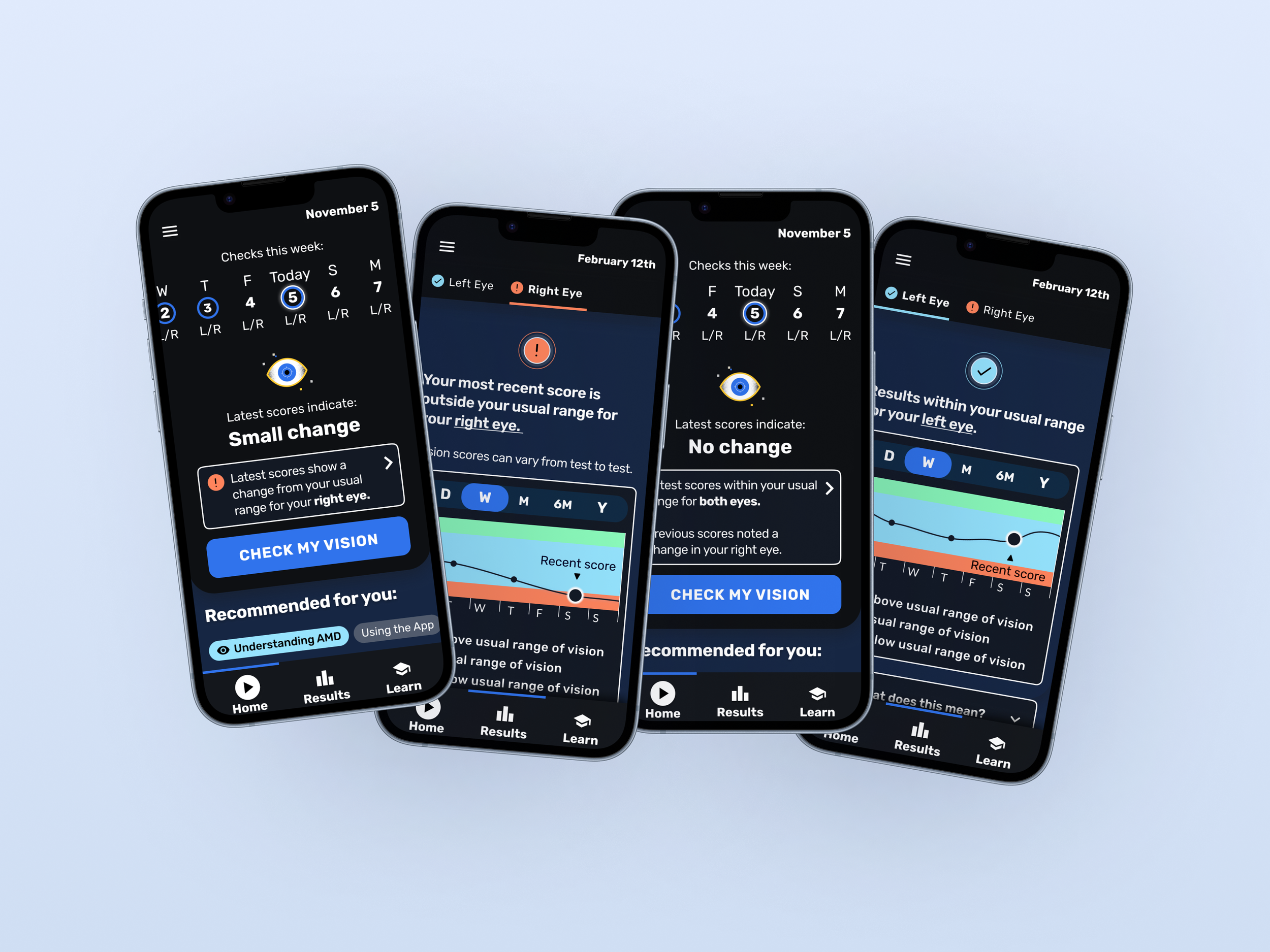
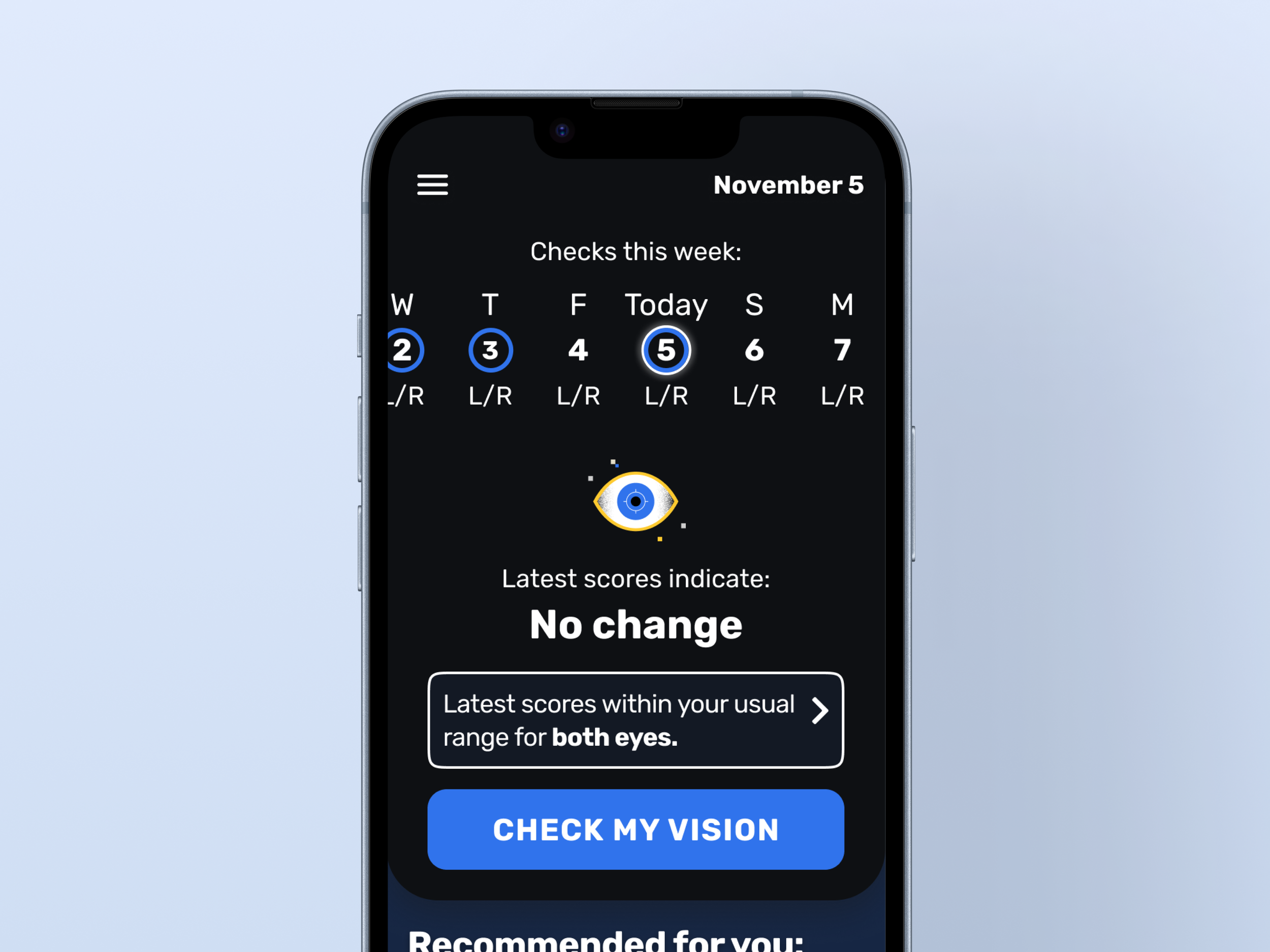
I introduced the idea of a "usual visual range", giving users a way to understand a result in relation to their own previous tests.
This shifted the experience from:
“How did I do today?”
to:
“Is this result consistent with my usual vision?”
I explored different combinations of summaries, status indicators and trend visualisations, prototyping each approach in Figma and testing them with users to understand which were easiest to interpret.
Designing for reassurance, not alarm
Because this was a health product, the way information was communicated mattered just as much as the information itself.
Testing showed that some visual cues and language could make an unexpected result feel more alarming than intended. I worked with the team to establish clearer language principles so that the experience remained observational rather than appearing to diagnose or give medical advice.
I removed unnecessary alarm signals and made it clearer that a single result doesn't necessarily indicate a change in someone's vision. Instead, repeat testing helps build a more reliable picture over time.
This was particularly important for a user group who may already be anxious about changes to their eyesight.
Accessibility was part of the design, not a final check
The product was being used by people with visual impairment, so accessibility needed to influence the design from the beginning.
I reviewed the interface against WCAG guidance and explored how colour, typography, contrast and information hierarchy affected comprehension.
I moved away from relying on clinical conventions such as red and green status colours and introduced a more legible typeface and clearer visual hierarchy.
The result was a lower-cognitive-load interface that communicated important information without relying on colour alone.
Helping users understand the bigger picture
Research also showed that new users didn't always understand why they needed to complete multiple tests before their "usual visual range" could be established.
I designed a new "Building your usual vision range" experience to make this process more transparent.
Rather than asking users to repeatedly perform the same test without context, the experience explains what is happening and why each test contributes to a better understanding of their vision.
Progress indicators and simpler explanatory content helped turn repetition into something meaningful.
From research to tested prototype
I brought the different ideas together into an end-to-end Figma prototype and tested the redesigned experience with patients.
The testing focused on three things:
Comprehension
Can people understand what their result is telling them?
Reassurance
Does the experience communicate change without creating unnecessary alarm?
Value
Do people understand why continuing to test is worthwhile?
I iterated the experience based on what I observed, refining both the visualisation and the language used to explain it.
The outcome
The final experience:
Reframed results around a person's usual visual range, rather than isolated scores
Made health information easier to understand without requiring clinical knowledge
Reduced opportunities for results to be misinterpreted as a diagnosis
Introduced a clearer explanation of how monitoring works over time
Created a more accessible visual language for people with visual impairment
Established a framework that could be extended to future monitoring and engagement features
Most importantly, the project changed the way the product communicated its value: from a tool that simply tests vision to one that helps people understand changes in their vision over time.